
How to Grow a Teaching YouTube Channel in 2026 (And Convert Free Viewers into Paying Students)
How to Grow a Teaching YouTube Channel in 2026 (And Convert Free Viewers into Paying Students)
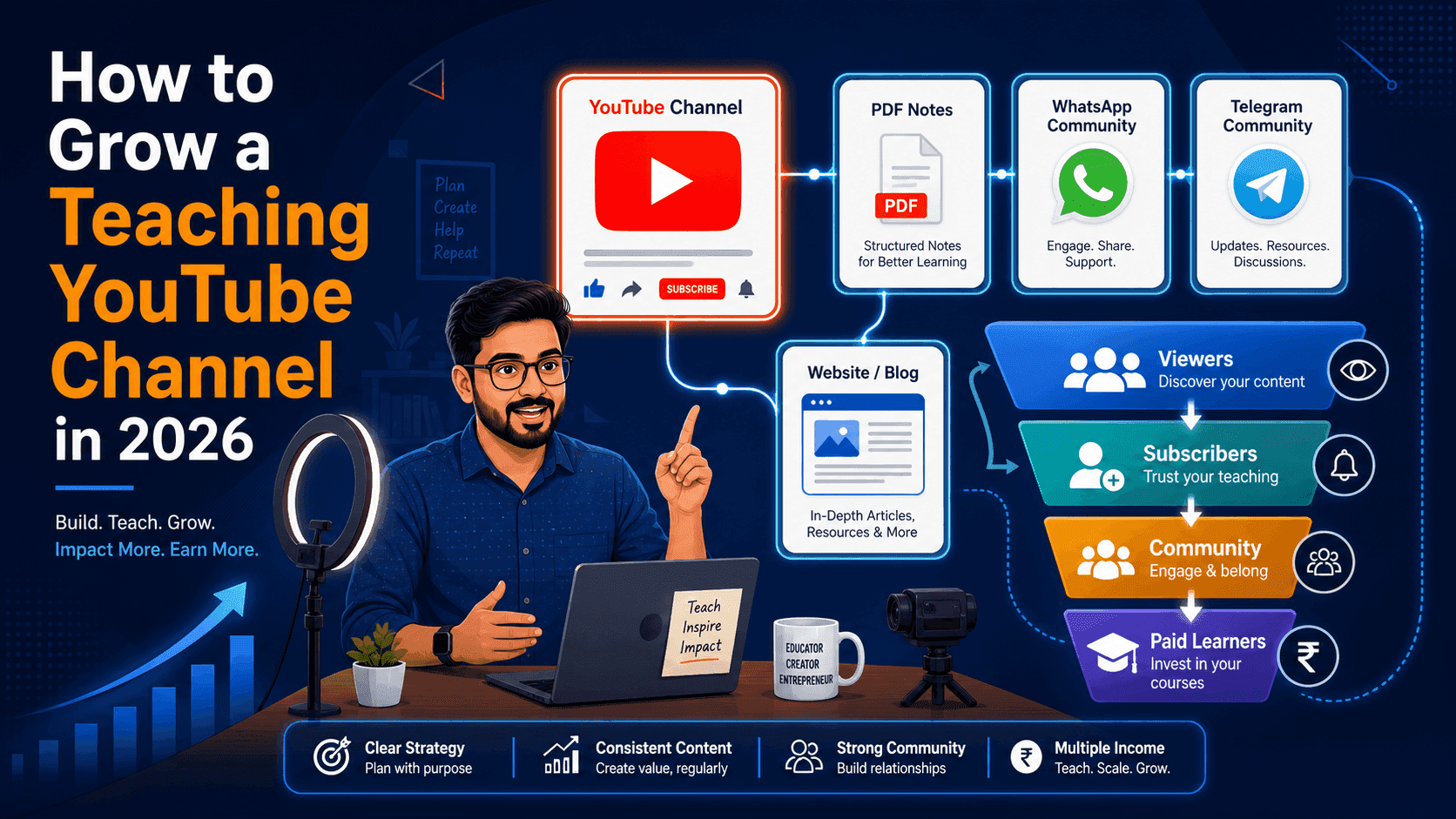
Great teaching is not enough if students cannot find, finish, remember, and share it. Many Indian educators upload useful lectures but still struggle to grow because the channel is treated as a video library instead of a learning system. The solution is not constant promotion. It is consistent free value, a clear content format, and a funnel that connects YouTube with notes, WhatsApp, Telegram and your website.
By the end of this guide, you will have a practical system for growing a teaching YouTube channel while building an audience you can serve through structured paid courses later.
Start with free teaching that earns trust
Free content should not feel like an incomplete advertisement for a paid course. A student who watches a free lesson should solve a real problem: understand a difficult concept, revise an exam topic, learn from a worked example, or avoid a common mistake. If the free lesson is vague, over-promotional or deliberately incomplete, viewers leave before they become an audience.
For a solo teacher, this means choosing one student question and answering it clearly. For a coaching institute, it means setting a quality standard across every faculty member. Check the explanation, examples, answer key, language and visual presentation before publishing. Trust grows when students repeatedly find that your free lessons are accurate and useful.
Make videos engaging, focused and easy to finish
Students do not owe a boring video their attention. Open with the problem, show what the student will be able to do, and move quickly to teaching. Replace long introductions with an example, a question, a visual explanation or a common exam trap. Use chapters, on-screen writing and short recap moments where they improve comprehension.
Keep a lesson as short as the topic allows. A focused video under 20 minutes is often easier to click and complete than a single long class. If a topic needs more time, divide it into a logical series: concept, solved examples, practice and revision. Short does not mean shallow; it means removing everything that does not help the learner.
Build consistency around a realistic schedule
Consistency is a promise students can understand. You do not need to upload every day if daily publishing will damage quality. Choose a schedule your team can maintain for six months. For example, a teacher may publish three focused lessons and one revision session each week. An institute may assign a fixed day to each exam or subject.
Create templates for thumbnails, descriptions, lesson openings and end screens, but do not make every video identical. Review audience retention, comments and repeated questions every week. Use that feedback to improve the next lesson instead of chasing every trend.
Use exam intent to decide what to publish
Teaching channels grow faster when they match the student’s immediate calendar. Before SSC CGL, JEE, NEET, UPSC or a state exam, students actively search for revision plans, previous-year questions, important topics, notification explanations and last-week mistakes. Build content around those moments without abandoning evergreen fundamentals.
- Track exam dates, notification changes and syllabus priorities.
- Create a revision series before demand peaks.
- Publish clear explanations of important updates.
- Offer a practice sheet or checklist with each major series.
- Update old descriptions and playlists when the exam cycle changes.
This approach helps a solo educator stay relevant and helps an institute coordinate faculty, notes and test-series production around the same student need.
Connect YouTube to WhatsApp and Telegram
Your YouTube channel should be the front door, not the entire house. Invite students into useful WhatsApp and Telegram communities where you can share reminders, practice questions, PDFs, polls, timetable updates and new lessons. Keep the purpose of each group clear. A noisy group with only promotions will lose trust quickly.
The funnel should work in both directions. YouTube brings new students into the communities. Communities bring students back to new YouTube videos. Use a consistent call to action: explain what the student will receive, link to the correct group, and deliver the promised resource immediately.
Use branded PDFs as a sharing engine
A branded PDF can be more powerful than another promotional message. Give away a useful revision sheet, formula guide, solved-question pack, class summary or exam checklist. The resource should have a clear structure, readable design and enough value that a student wants to forward it.
Place your channel name, visual identity and YouTube reference naturally inside the notes—not as an intrusive advertisement. Add the relevant playlist or channel direction where it helps the reader continue learning. When students share notes in their class groups, your teaching identity travels with the resource.
Turn one lecture into a content system
One well-planned lecture can create a complete week of useful content:
| Source | Repurposed asset |
|---|---|
| Lecture | Focused YouTube lesson or series |
| Explanation and examples | Branded PDF notes and practice sheet |
| Common questions | Community poll, short video or FAQ |
| Search intent | SEO blog for the website |
This system saves production effort while giving students multiple ways to learn. The blog can capture search traffic, the video can demonstrate teaching quality, and the communities can nurture the relationship.
Free content and paid courses can work together
Free lessons attract attention and prove your teaching. Paid courses provide a complete path: structured modules, tests, doubt support, progress tracking and deeper practice. Do not hide the value of free education to protect a paid course. Instead, make the free layer genuinely useful and make the paid layer meaningfully more complete.
Measure the journey: video views, meaningful watch time, PDF downloads, community joins, repeat viewers and paid-course enquiries. A large view count with no returning students is not the same as a healthy learning business.
A practical weekly operating system
- Select one exam-relevant problem from comments and student questions.
- Write a short outline with one promise and three to five teaching points.
- Record an engaging lesson and edit unnecessary pauses.
- Create a branded PDF or practice resource.
- Share the lesson and resource in WhatsApp and Telegram.
- Publish a search-friendly website article from the same teaching insight.
- Review retention and questions before planning the next lesson.
When to get production support
As the audience grows, teachers often become the bottleneck. Converting lectures into polished notes, maintaining SEO blogs, preparing branded resources and managing communities can consume the time needed for teaching. A practical option is to outsource those production tasks while keeping the academic direction, review and intellectual property under your control.
ScaleEdTech can support lecture-to-notes conversion, structured study material, SEO blogs and Telegram/WhatsApp management for educators and institutes that want to build this engine without adding a large internal content team. The principle remains simple: the teaching must stay useful, consistent and owned by the educator or institute.
Key takeaways
- Give real value in free lessons before asking students to buy.
- Prefer focused, engaging videos over unnecessarily long classes.
- Plan around exams, revisions and current notifications.
- Connect YouTube with useful WhatsApp and Telegram communities.
- Use branded PDFs so shared resources also spread your channel identity.
- Turn one lecture into video, notes, blog and community content.
Article Summary
A practical 2026 playbook for educators: grow a teaching YouTube channel with high-value free lessons, branded notes, exam-focused content and communities.
Want this standard inside your institute?
20-minute discovery call. Plan in 24 hours.