Why Generic AI-Generated Study Material Can Damage Your Coaching Brand
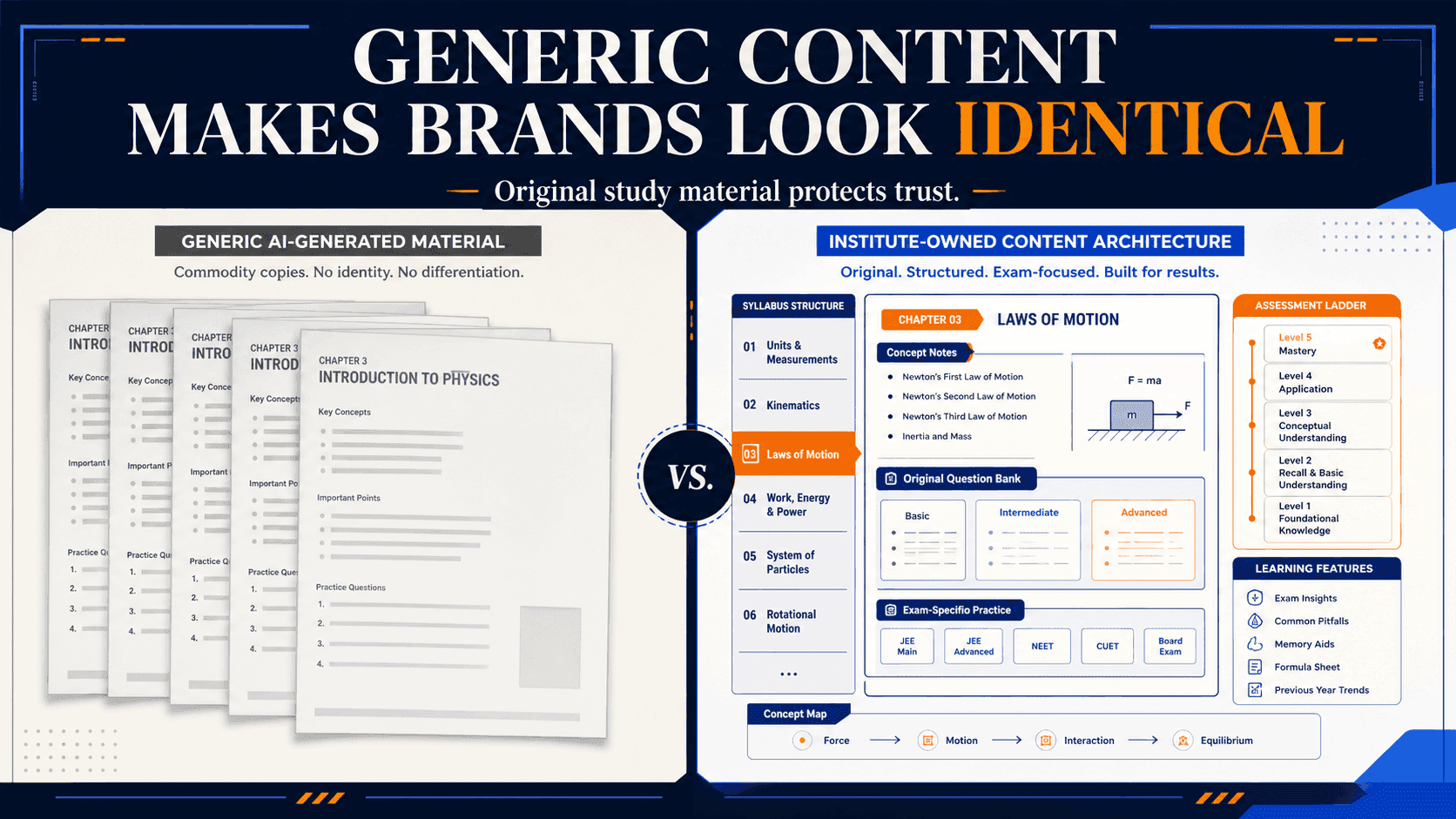
The real risk is not AI. It is unowned content.
Generative AI can create notes, questions and explanations quickly. That speed is useful when an institute has a syllabus deadline, a new batch to prepare or hundreds of files to format. The problem begins when fast output is treated as finished educational material. A coaching institute does not sell words on a page. It sells accuracy, exam relevance, clarity and trust.
When generic AI study material reaches students without expert ownership, the damage appears in several places at once: an incorrect answer weakens confidence, a copied explanation makes the institute look ordinary, and a repeated question wastes valuable practice time. Students may never blame the tool. They blame the brand printed on the cover.
This guide explains how to use AI safely as a production assistant while keeping subject experts responsible for the academic standard.
Why generic AI study material fails in real classrooms
AI tools are trained to produce plausible language. Exam material needs something stricter: a correct answer, a defensible explanation, the right difficulty and a direct connection to the target syllabus. A paragraph can sound polished and still be unsuitable for SSC CGL, JEE, NEET, UPSC or a state-level examination.
- Facts can be incomplete. A summary may omit a qualification that changes the answer.
- Examples can be generic. Students need the patterns and traps that appear in their examination, not a textbook paragraph.
- Questions can be repetitive. Similar prompts create the appearance of volume without improving practice.
- Answer keys can be wrong. One wrong key can teach an entire batch the wrong method.
- Language can miss the learner. Literal translation, awkward Hindi or unexplained terminology reduces comprehension.
How the brand damage compounds
The first error is academic. The second is commercial. Students compare notes, tests and PPTs across institutes, especially in coaching hubs and WhatsApp groups. If your material looks like a generic AI output or contains mistakes that students find through a quick search, they begin to question the rest of your teaching system.
Parents also inspect what they can physically see. A branded PDF with weak explanations, inconsistent terminology and unexplained answer keys becomes evidence that the institute is cutting corners. The result may be fewer referrals, weaker renewals and pressure to compete on fees rather than outcomes.
| Failure | What students experience | Brand consequence |
|---|---|---|
| Wrong answer key | Confusion during revision | Lower trust in tests and faculty |
| Generic examples | Little connection to the exam | Material feels interchangeable |
| Repeated questions | Less useful practice | Students look elsewhere for quality |
The human-in-the-loop standard
Use AI where it removes repetitive production work, not where it replaces academic accountability. A reliable workflow has separate lanes:
- Briefing and syllabus mapping. Define the exam, unit, learning outcome, question type, language and difficulty before drafting.
- Assisted drafting. Use AI for outlines, alternative explanations, formatting support or first-pass variations.
- Subject-expert review. A qualified expert verifies every fact, formula, answer, example and exam claim.
- Independent quality check. A second reviewer checks duplication, language, difficulty, formatting and branding.
- Platform or classroom test. Open the final PDF, PPT or test as a student would before release.
The key rule is simple: AI may accelerate production, but a named human owns the final academic decision.
A practical quality checklist for AI-assisted content
- Map each section to the latest official syllabus.
- Verify facts against reliable primary or institutional sources.
- Recalculate numerical answers independently.
- Check every answer key by solving the question, not by trusting the draft.
- Compare difficulty with recent PYQs and your own test blueprint.
- Remove repeated questions, filler explanations and unsupported claims.
- Review English, Hindi or regional-language terminology with a subject person.
- Check copyright, attribution and ownership before distribution.
- Apply consistent headings, fonts, page numbering, branding and file names.
- Keep a version log so corrections reach every copy.
Make material recognizably yours
Trust grows when study material reflects the way your faculty teaches. Add your own shortcuts, common mistakes, PYQ mapping, local examples, revision sequence and difficulty labels. A generic explanation can become valuable when it is reorganized around your pedagogy and checked against your students' needs.
Use a repeatable content template: concept explanation, worked example, common trap, exam connection, practice questions and quick revision box. This creates consistency without making every chapter sound mechanical. The structure belongs to your institute even when AI helped with an early draft.
Where AI helps—and where it should stop
| Good uses | Human responsibility |
|---|---|
| Outline variations and formatting | Syllabus coverage and teaching sequence |
| Translation suggestions | Meaning, terminology and cultural clarity |
| Draft question formats | Correctness, originality and difficulty |
| File organization and summaries | Final approval and student safety |
Build a review record, not just a final PDF
For every module, keep a small review record with the source, reviewer, date, corrections and approval status. This matters when a syllabus changes or a student reports an error. You can trace the version, correct the master file and prevent an outdated PDF from returning through an old upload folder.
For tests, add a question-level review sheet. Record the correct option, explanation, topic, difficulty and reviewer initials. It takes more time at the start, but it prevents the expensive cycle of student complaints, emergency corrections and re-uploaded files.
The safe operating model for coaching institutes
Institutes do not need to ban AI, and they do not need to hand their brand to an unverified generator. The strongest model combines technology-enabled production with subject experts, independent review and platform-ready delivery. Faculty supplies academic direction; the production team handles drafts, formatting, translations, PPTs, notes, question banks and test-series preparation; reviewers protect the standard.
That is the role of ScaleEdTech's educational content development services: structured notes, question banks, test series, premium PPTs and format conversion produced under your brand, with expert review and 100% IP exclusivity. The value is not AI output alone. It is a controlled system that delivers usable material without making students the testing ground. If you are auditing your current workflow, request a discovery call and map one subject before scaling the full library.
Conclusion
AI is valuable when it supports a disciplined content operation. It becomes dangerous when speed is mistaken for accuracy, originality or ownership. Keep the syllabus, answer key, difficulty, language, review and final approval under human control. Then use technology to reduce repetitive work and help your institute deliver better material faster.
A controlled review process protects student outcomes and the long-term credibility of the institute.
Key Takeaways
- AI speed does not guarantee exam accuracy or originality.
- Wrong answers and generic explanations damage trust in the institute's brand.
- Use syllabus mapping, expert review and independent quality checks.
- Build material around your pedagogy, PYQs and student needs.
- AI can assist production, but humans must own final academic accountability.
Article Summary
Learn how coaching institutes can use AI-assisted study material safely with expert review, syllabus alignment, original pedagogy and quality controls.
Frequently Asked Questions
Want this standard inside your institute?
20-minute discovery call. Plan in 24 hours.


