Why Your Study Material Looks Like Your Competitor's (And How It's Hurting Your Brand)
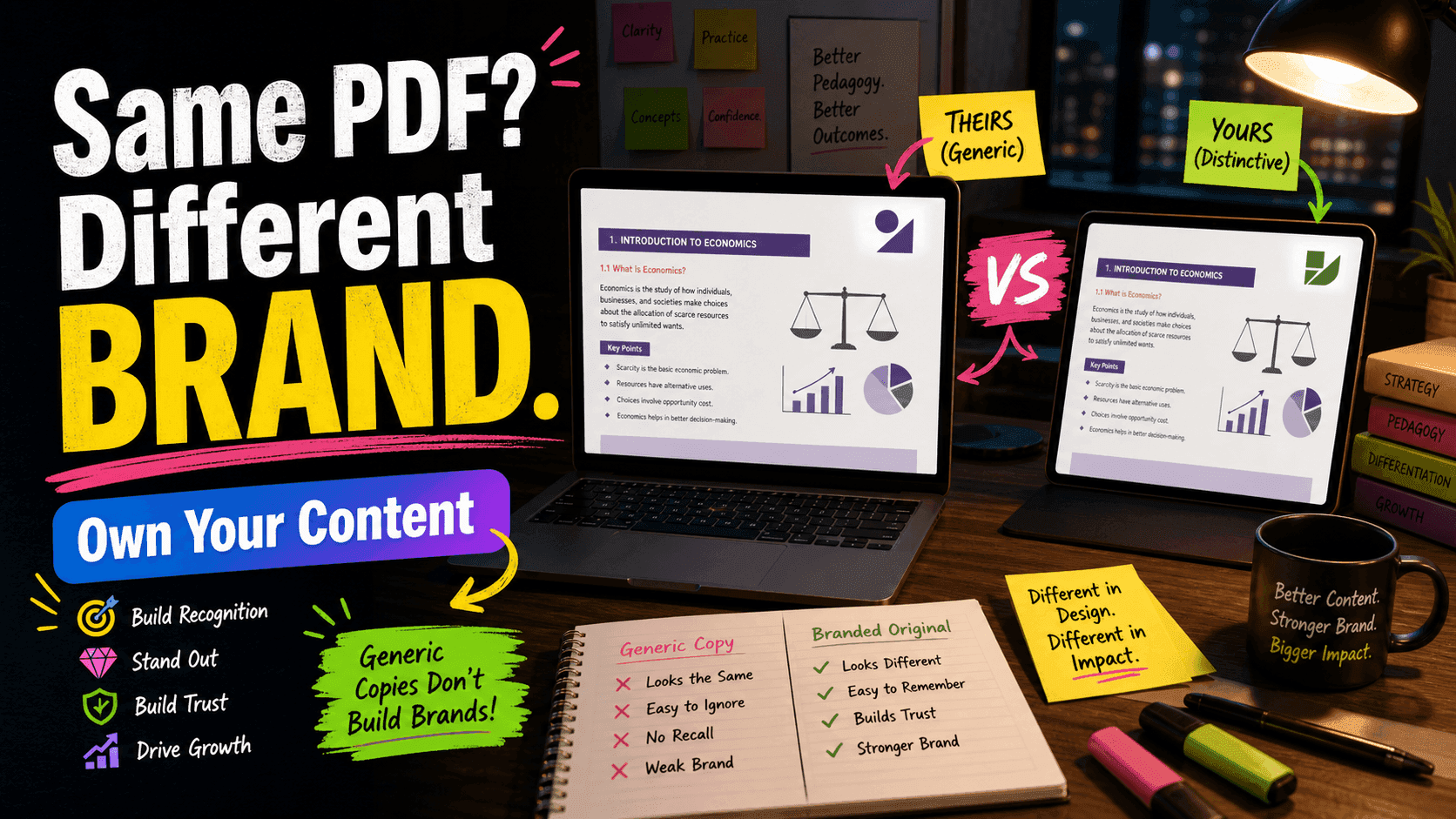
A student holds your notes in one hand and your competitor's in the other. They're the same PDF with different logos.
This isn't a hypothetical. In every coaching hub — Kota, Delhi, Jaipur, Prayagraj — students compare material across institutes daily. And more and more often, they're discovering something uncomfortable: it's the same material. Same structure, same examples, same typos, different cover page.
If you run a coaching institute or teach independently, this article shows you how generic content spreads, what it silently costs you, and how to make your study material something competitors cannot copy.
The two-notes test
Before reading further, try this:
- Take one chapter of your notes.
- Place it next to the same chapter from two nearby competitors.
- Cover the logos.
- Ask a student: whose is whose?
If they can't tell — and in most cases they can't — your material is not building your brand. It's building the category's brand, and you're competing on price alone.
And price-only competition is the most expensive game in coaching. When notes, test series, and PPTs look interchangeable across institutes, the fee becomes the only visible difference — so discounting becomes your only lever, and every discount trains the market to wait for a bigger one. Institutes with visibly distinctive material never enter this loop: they get compared on quality, results, and student experience instead of price.
How generic content spreads
Study material goes generic through three doors, and most institutes have walked through at least one:
1. The content market. There are wholesale content sellers who sell the same question banks, notes, and test series to every institute in a region. The economics feel great — until you realize five of your competitors bought the identical files.
2. The same AI tools. ChatGPT-generated notes look like ChatGPT-generated notes. Same headings, same phrasing, same generic examples. When you and your competitor prompt the same tool for "Class 12 Physics notes on rotational motion," you get near-identical output — and students who use these tools daily recognize the style instantly.
3. Recycled freelance work. A freelancer who made your test series last year is making your competitor's this year — often starting from the same files. Without a contract that transfers ownership, nothing stops this. It's not even illegal; you never owned the content.
What students (and parents) conclude
Students rarely complain about duplicate material. They just quietly re-rank you.
Here's the reasoning that happens in their heads: "If the notes are the same everywhere, then the only difference between institutes is the teacher and the fee. Why am I paying more here?"
For parents, it's sharper: material is the only part of your teaching they can physically inspect. When the books they paid for look like everyone else's — or worse, like something printed off the internet — your entire institute gets mentally filed under "ordinary."
Exclusive material flips this. When your notes have your structure, your shortcuts, your PYQ mapping, your design — they become a reason to join and a reason to stay.
The WhatsApp effect
One more reality of 2026: duplicates don't stay hidden.
All it takes is one student with a sibling in a rival institute. One photo of two identical pages, side by side, posted in a class WhatsApp group. Within a day it's in the parents' group. Within a week it's a joke in the student community.
You will never see this happen — you'll only see the admission enquiries slow down next cycle. Reputation damage from copied material is invisible, delayed, and expensive.
The real cost: what generic material does to your numbers
"Brand erosion" sounds abstract, so map it to the four places it actually hits revenue:
1. Lost premium pricing. Exclusive, branded material is one of the few tangible justifications for a higher fee. Without it, you're pushed toward matching the cheapest competitor — and a 10–15% fee compression across one batch cycle usually costs more than a full year of custom content development would have.
2. Higher drop-offs between batches. Students who see nothing unique about your material have no switching cost. When a rival offers a discount, there is nothing anchoring them to you beyond one teacher's personality.
3. Weaker word-of-mouth. Distinctive notes get photographed, shared, and asked about — "where are these notes from?" is free marketing that runs in every student group. Generic notes generate zero conversation.
4. Zero asset value. Rented or market-bought content disappears the day you stop paying for it. Owned content compounds: every batch, every year, your library becomes a bigger moat — and a real, transferable asset if you ever expand, franchise, or sell.
Run those four against your own enrollment numbers and the "cheap" market PDF stops looking cheap.
White-labeling vs true ownership: know what you're buying
Here's where most institutes get trapped by vocabulary. "White-labeled content" sounds like ownership. It usually isn't.
| What you have | What it actually means |
|---|---|
| Market-bought PDFs | Zero exclusivity — anyone can buy the same files tomorrow |
| "White-labeled" content | Your logo on shared content — the seller keeps reselling it |
| Licensed content | You can use it; you don't own it; terms can change |
| Signed IP transfer | The content is legally yours — it can never be resold, reused, or shared |
Only the last row protects your brand. If your current vendor cannot show you a clause that transfers intellectual property to you exclusively, you are renting your study material — and so is your competitor.
Five questions to ask your content vendor this week
You don't need a lawyer to find out what you actually own. Ask your current vendor these five questions, in writing:
- "Who else uses this exact content?" — If the answer is vague, assume the worst.
- "Can you show me the clause that transfers IP ownership to me?" — Not a license, not "usage rights": ownership.
- "What happens to my files and editable source documents if we stop working together?" — If they keep the source files, they keep the ability to resell.
- "Was this written by subject experts, or AI-generated and edited?" — You deserve to know what you're putting your logo on.
- "Will you give me category and region exclusivity in writing?" — A vendor confident in their model will; a reseller can't.
Two evasive answers out of five means it's time to change how you source content.
Checklist: 6 signs your material is not exclusive to you
Run this audit this week:
- [ ] You bought ready-made PDFs or question banks from a content market or Telegram seller
- [ ] Your notes were generated mostly by AI tools with light editing
- [ ] You have no written agreement mentioning IP ownership or exclusivity
- [ ] Your vendor also serves other institutes in your exam category
- [ ] Your material contains examples, phrasing, or errors you've seen elsewhere
- [ ] A student has ever mentioned that another institute has "the same notes"
One checked box is a warning. Two or more means your material is actively working against your brand.
Making your material unmistakably yours
Exclusive material isn't just legally yours — it should be recognizably yours:
- Your pedagogy, captured. The shortcuts, mnemonics, and explanation sequences your faculty actually use in class — written into the notes. This is content no market PDF can ever have.
- Your design system. Consistent branding, typography, and layout across every book, test, and PPT — so a single page is identifiable as yours even without the logo.
- Your exam intelligence. PYQ mapping, difficulty tagging, and examiner-style questions built for your students' target exams — not generic "all exams" filler.
- Ownership on paper. A signed IP transfer so the material can never appear anywhere else.
Can't rebuild everything at once? Sequence it
Replacing an entire content library in one shot isn't realistic for most institutes — and it doesn't need to be. A phased approach works:
- Phase 1 — the flagship subject. Start with the subject that drives the most admissions or where competition is fiercest. Exclusive notes and tests here deliver the fastest visible differentiation.
- Phase 2 — student-facing material. Books, printed notes, and test series that parents and students physically handle — the highest-visibility surface for your brand.
- Phase 3 — everything else. DPPs, internal worksheets, PPTs, and digital content, converted batch by batch.
Most institutes can complete Phase 1 before their next admission cycle — which is exactly when distinctive material pays for itself.
Article Summary
A practical guide to making coaching study material original, recognisable and legally exclusive instead of interchangeable with competitor PDFs.
Frequently Asked Questions
Want this standard inside your institute?
20-minute discovery call. Plan in 24 hours.