
Buy vs Build: When Outsourcing Content Beats Hiring a Content Team
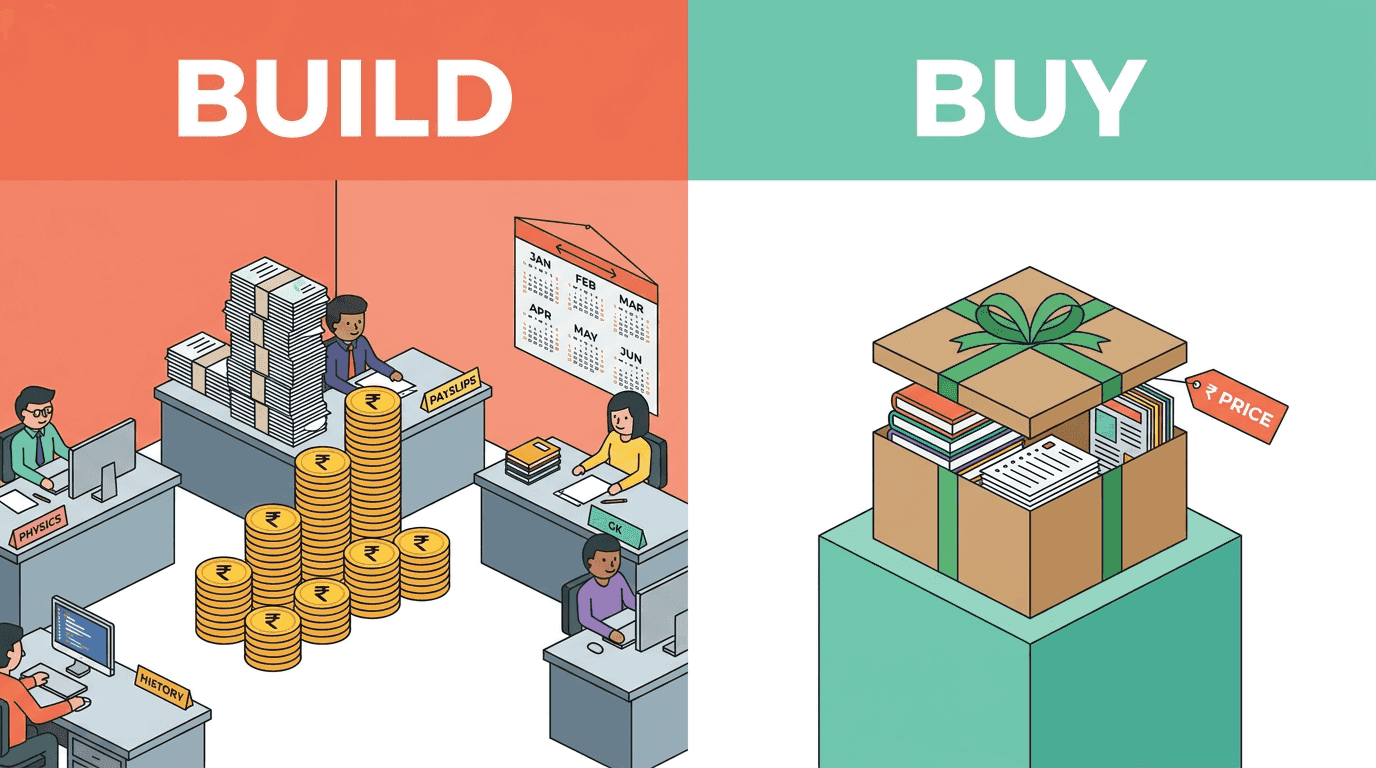
₹35,000 a month for a content writer. ₹4 lakh+ a year — and your test series is still "next month, sir."
Every growing coaching institute reaches this crossroads. Admissions are up, a new exam course is planned, students are asking for better notes and more mocks — and the instinctive answer is: "Let's hire a content person." Sometimes that is the right call. Often it is the most expensive mistake of the year. Here is the honest buy-vs-build comparison, in real numbers, that most owners run only after the first hire has already gone wrong.
What an In-House Content Team Really Costs
Here is the mistake most owners make: they budget for one content writer. But no single writer covers Physics, Chemistry, Maths, Biology, English, Reasoning, and GK. A real multi-subject course needs one subject expert per subject — plus daily content creators for current affairs and daily practice questions, plus design. At typical rates in Indian coaching hubs:
| Role | Typical count | Monthly salary (each) | Annual cost |
|---|---|---|---|
| Subject-matter experts (one per subject) | 3–5 | ₹35,000–₹60,000 | ₹12.6–36 lakh |
| Daily content creators (current affairs, daily quizzes) | 1–2 | ₹25,000–₹40,000 | ₹3–9.6 lakh |
| DTP / design operator | 1–2 | ₹18,000–₹30,000 | ₹2.2–7.2 lakh |
| Editor / reviewer (usually your academic head) | 1 | Unbudgeted | Unbudgeted |
Add it up honestly: a content team that actually covers a multi-subject course is six to nine people and lands between ₹18 and ₹50+ lakh a year — before software, hardware, PF/ESI, annual increments, or a single approved page. The ₹35,000 at the top of this article is not the cost of an in-house content team; it is the cost of one seat in it.
The Four Costs That Never Appear in the Budget
- The training runway. Even a good hire takes two to three months to learn your format, difficulty calibration, and language style. You pay full salary through a quarter of near-zero usable output.
- Attrition. Content people in coaching hubs like Kota and Delhi are poached constantly. When a writer resigns midway through your test series, the half-finished question bank, the format knowledge, and your launch date all walk out together.
- Management overhead. Someone must assign chapters, chase deadlines, review drafts, and manage rework. That someone is usually your academic head — whose time was supposed to go into teaching and results.
- Idle capacity. Content demand is seasonal: brutal before a course launch, light afterwards. Salaries, unfortunately, are monthly. You pay peak-load money through off-peak months.
What Outsourcing Actually Costs — and What You Get
Outsourced educational content development services work on a per-project or per-item basis: a notes module, a 3,000-question bank, a 40-test series, a full PPT set. You pay for output, not attendance — and the differences run deeper than price:
| Dimension | In-house team | Outsourced development |
|---|---|---|
| Cost model | Fixed salaries, 12 months a year | Pay per project, only when needed |
| Speed to start | 1–2 months hiring + 2–3 months training | Production starts within days |
| Consistency | Depends on who stays | Templates and QC survive any individual |
| Scaling for a launch | Hire more people | Add capacity for one project |
| Risk | Attrition can stall a launch | Delivery is contractual |
When you evaluate the best content outsourcing companies for education, judge them on four things: genuine subject experts (ask who writes and who reviews), delivery in your exact format (print-ready, LMS-ready, test-platform-ready), a clear revision policy, and written IP terms.
Why the Case for Outsourcing Gets Stronger as You Grow
Conventional wisdom says bigger institutes should build bigger in-house teams. The salary maths above says the opposite: every new subject, batch, and daily-content commitment adds heads to the payroll, and that payroll grows faster than the course revenue it supports.
| Institute stage | What in-house really means | The outsourced alternative |
|---|---|---|
| Under 300 students, 1–2 exams | A ₹18 lakh+ payroll that eats the entire margin | Pay per module; margins stay intact |
| 300–1,500 students, adding courses | New hires and a fresh training runway for every course launch | Add project capacity for the launch, release it after |
| 1,500+ students, daily content operations | 6–9+ salaries, with attrition risk multiplied across every subject | Contracted daily and project delivery at a fraction of payroll |
The one function worth keeping in-house at every size is final academic judgment — your academic head approving what reaches students. Everything else — subject writing, daily current affairs, question banks, design, formatting, LMS preparation — is production, and production is what you buy.
The Question That Decides Everything: Who Owns the Content?
An employee's work is yours by default. A vendor's work is yours only if the agreement says so — explicitly. Insist on 100% IP exclusivity: the material is created for you, transferred to you, and never resold or template-recycled for another institute. Without that clause, your "exclusive" test series may be answering questions in a rival's classroom next season.
This is the standard ScaleEdTech's educational content development services are built around: notes, question banks, test series, and PPTs written by subject experts in your format, delivered under your brand with 100% IP exclusivity — you own the material outright, forever. If you are weighing an offer letter against an outsourcing quote this session, book a discovery call and compare the real numbers for your specific courses before you commit to either.
Key Takeaways
- One writer's salary is a decoy: a real multi-subject content team is 6–9 people and ₹18–50+ lakh a year.
- The hidden costs — training runway, attrition, idle months, review load — hurt more than the salaries.
- Outsourcing converts that fixed payroll into per-project spending and starts producing within days.
- The bigger the institute, the more subjects and daily content multiply headcount — and the stronger the case for outsourcing production.
- Keep only final academic review in-house, and secure 100% IP ownership in writing.
A Safer Decision Process Before You Sign
Do not compare only the monthly quote with a salary. Compare usable output, review responsibility, turnaround, revision limits, source ownership, and what happens when demand doubles before an admission cycle. Ask every provider for a sample workflow: brief, first draft, subject review, correction round, final files, and delivery formats.
A sensible pilot is one chapter, one test module, or one short notes pack. Define acceptance criteria before work begins: syllabus coverage, difficulty level, language, branding, file format, and deadline. If the pilot passes, expand the scope. If it fails, you have limited the risk and learned exactly where the process needs correction.
The strongest model is rarely a permanent either-or decision. Keep the academic head close to the syllabus, standards, and final approval; use flexible production capacity for writing, formatting, design, question creation, and LMS preparation. Review the economics every six months as student count, exam mix, and launch frequency change.
Measure the Result, Not Just the Invoice
After delivery, compare the agreed scope with the usable output. Record how many pages, questions, tests, slides, or files passed first review; how many needed correction; and whether the final package arrived in the formats your students actually use. Also record the internal hours spent briefing, reviewing, and uploading.
These numbers make the next decision objective. A low quote that creates heavy rework may cost more than a higher quote that delivers clean, platform-ready material. A salaried team that is idle for half the year may be less efficient than a smaller internal review function supported by project capacity during launch months. The right answer is the model that protects quality, ownership, speed, and cash flow together.
Article Summary
Real salary maths for Indian coaching institutes: in-house content team vs outsourcing — cost, speed, consistency, and who owns the content.
Frequently Asked Questions
Want this standard inside your institute?
20-minute discovery call. Plan in 24 hours.